Flotration Technologies · CAST
How CAST connects
We don’t tear out. We tee in. · No additional power · No moving parts · Patent pending
Non-confidential · August 2026 · Not a technical specification or offer of terms
Hydraulic path
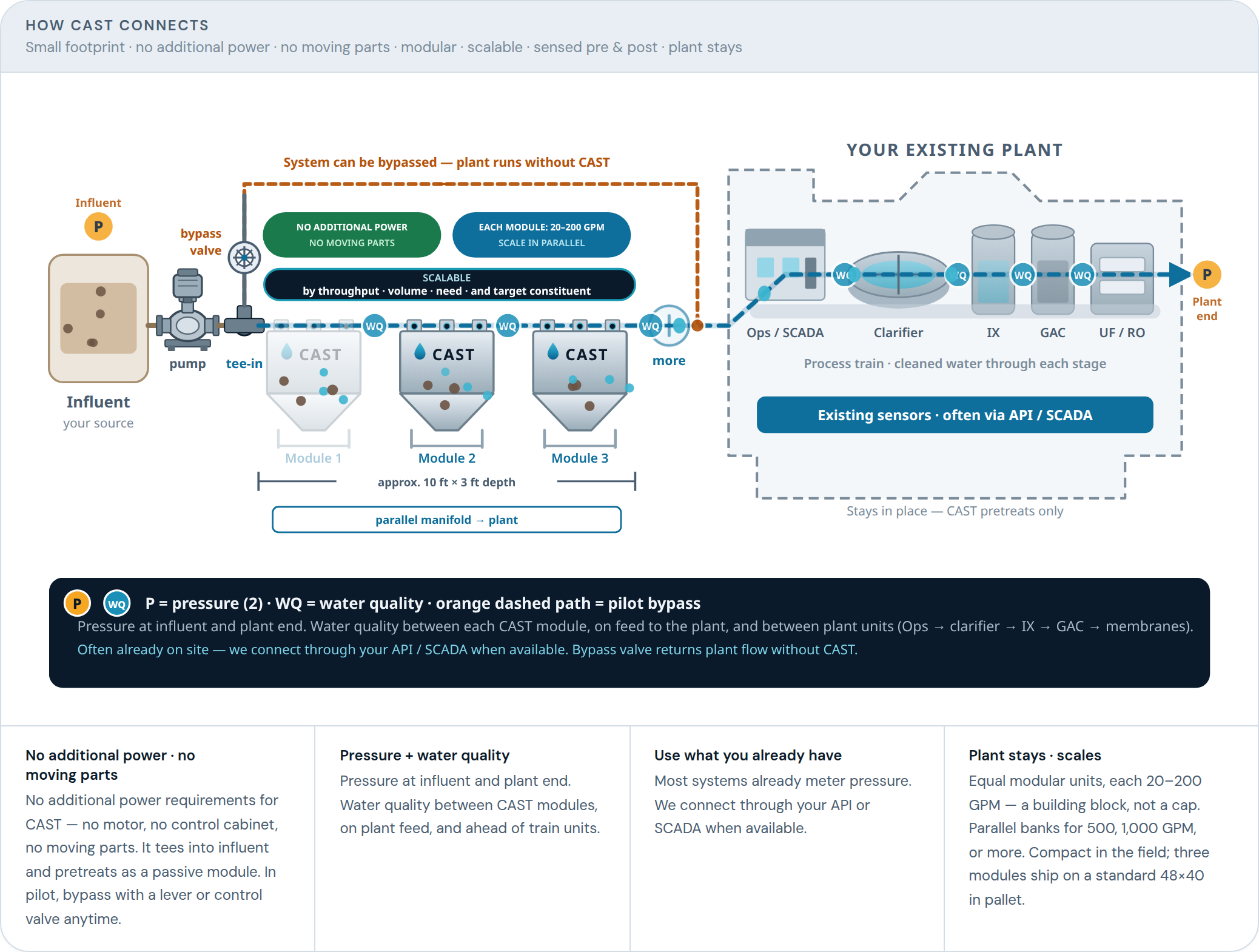
- Influent from your source feeds a pump, then a tee-in at the top ports of each CAST module.
- Treated flow leaves CAST through a parallel manifold into your existing plant (clarifier, IX, GAC, UF/RO, or as configured).
- CAST pretreats only — the plant stays in place. We don’t tear out. We tee in.
Bypass (pilot-ready)
- A bypass valve at the tee-in can redirect flow around CAST so the plant runs without CAST.
- Especially useful in pilot: flip a lever or control valve anytime.
Footprint, power, and modules
- Small pad at the plant — not a rebuild. For shipping: three CAST modules fit on a standard 48×40 in pallet (transport scale, not how each unit sits in the field).
- No additional power requirements. No electricity required for CAST itself. No moving parts.
- Each module: 20–200 GPM. Higher total flow by assembling modules in parallel — a building block, not a ceiling.
- Scale by throughput, volume, need, and target constituent of concern.
Sensing
- Pressure sensors at influent and at plant end.
- Water quality sensing between CAST modules and between stages in the plant train where applicable.
- Most systems already meter key parameters — Flotration connects through your API or SCADA when available.
Service and fouling
- Fouling response depends on water quality and the target constituent of concern.
- Lift the inner workings of the CAST and pressure-wash as needed. Aluminum construction is essentially non-fouling.
Engagement path
- Basic intake → 60-minute scoping call → one-page ROI → paid on-site pilot to prove performance on your stream.
- After proof-up: water-as-a-service commercial model (savings-share), not a large CapEx purchase to start.