Fine solids that pass conventional clarification
Colloidal and sub-micron loads drive turbidity, foul membranes, and shorten ion-exchange and carbon life.

Upstream pretreatment for the system you already run.
Flotration's patent-pending CAST technology uses capillary action and hydrodynamic cavitation — — to pull out suspended solids, oils, and organics, and turn a share of your dissolved load into solids we can remove too. Independent third-party bench testing showed more than 8× longer ion exchange run life before breakthrough when CAST ran ahead of IX. No chemicals, no membranes, no added power.
Capillary Action
Separation Technology
We don’t tear out. We tee in.
Each module up to 200 GPM. Proven on your water in a paid pilot before you scale.
Start client intakeEstimate savings (ROI)How CAST connectsHow we work: prove it, don't tear out, share the savings. Our mission
Building block · not a ceiling
200 GPM per module — scale by adding units
Parallel banks for higher flow. Same CAST module, repeated.
CAST pretreats ahead of the system you already run — capillary action and hydrodynamic cavitation remove suspended solids, oils, and organics, and convert a reactive share of dissolved load into solids that can be separated. No chemicals, no added power. Proven on your water in a paid pilot. Patent pending.
Advisors · testing · SBIR

Strategic advisor

Independent testing
Formerly ECT2 · Formerly ECT2. Bench & field results for CAST pretreatment. View results

SBIR Phase I
U.S. Air Force · PFAS/PFOS
The problem
Fine suspended solids, oils, and organics — the constituents of concern that conventional trains struggle to take out economically — drive most of the cost and risk.
Colloidal and sub-micron loads drive turbidity, foul membranes, and shorten ion-exchange and carbon life.
IX, GAC, UF/RO, and other trains absorb the cost of poor pretreatment — more regenerations, more cleanings, more downtime.
Operators are pushed toward expansion projects when the smarter move is often better water quality upstream.
Produced water, PFAS-impacted streams, and municipal reuse need reliable polish without reinventing the plant.
The solution
Capillary Action Separation Technology
CAST uses capillary action separation to strip fine suspended solids, oils, and organics from challenging source water before it hits clarification, membranes, ion exchange, or carbon. You keep your plant — and give it cleaner water to process.
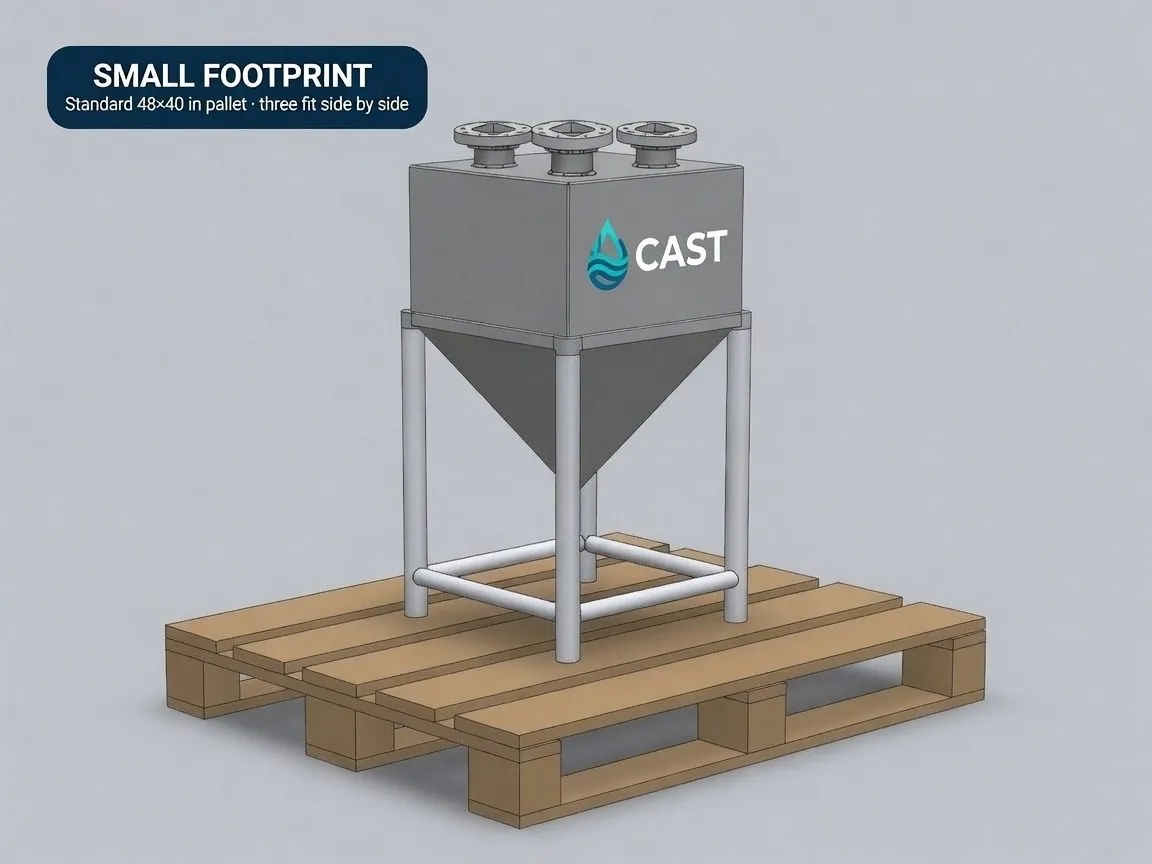
Single CAST module (stand shown for scale) — up to 200 GPM each; three ship on a 48×40 in pallet; add modules in parallel for higher flow
How it works
CAST tees into your influent and sends cleaner water into the treatment you already run. Footprint stays small; you keep your system. In a pilot, CAST can be bypassed with a flip of a lever or control valve so operations run as before.
The unit
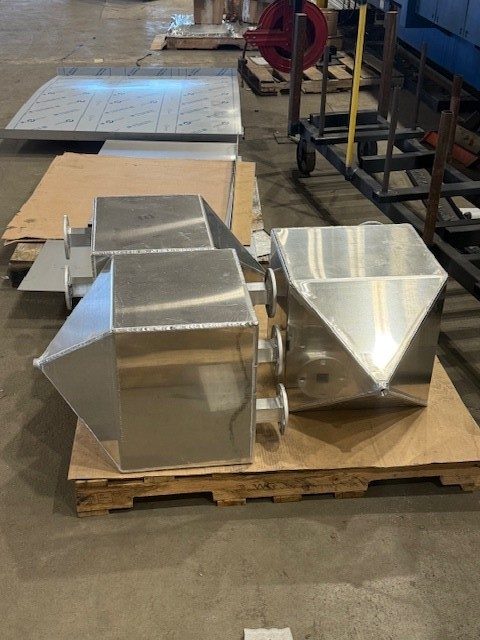
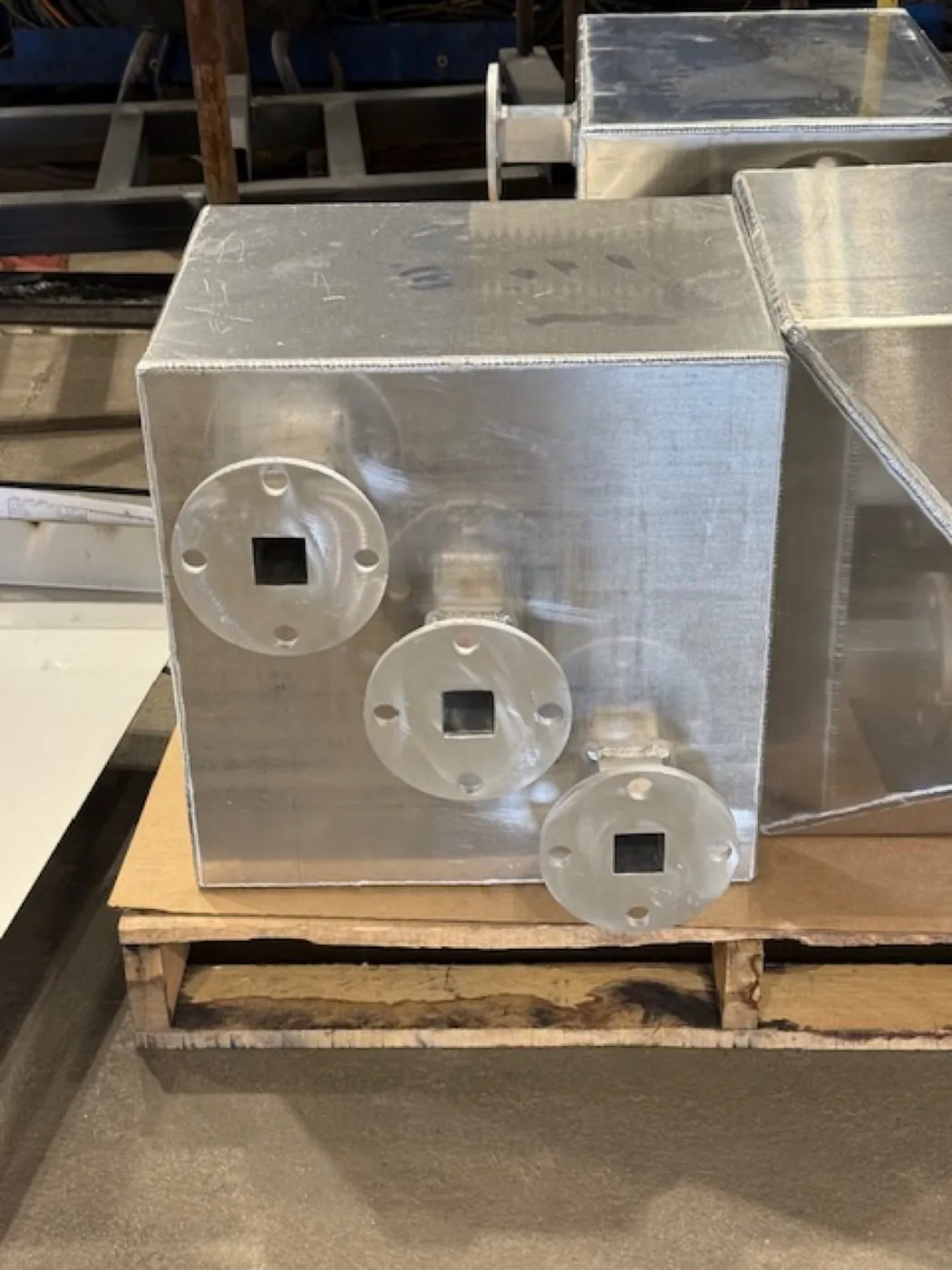
Performance
Bench and pilot ranges — site-specific confirmation is the point of the paid pilot. Data collection and review are structured so results can be evaluated with advisor-grade rigor. Tap a range for the supporting detail.
Engineer-facing: CAST combines capillary action separation with hydrodynamic cavitation to act on both the suspended and the reactive-dissolved fractions of a stream. Cavitation-driven degasification raises pH by stripping dissolved CO₂, shifting the carbonate equilibrium toward precipitation of carbonate hardness. At the same time, cavitation elevates ORP through in-situ generation of reactive oxygen species and entrained dissolved oxygen, oxidizing and hydrolyzing redox-active species (e.g. ferrous iron to ferric hydroxide; manganese(II) to manganese oxides — manganese typically slower and prefers higher pH than iron), with co-precipitation of associated metals. This transfers a defined, reactive fraction of dissolved solids into the particulate phase for separation with native suspended solids, oils, and organics. Extent is stream-specific and confirmed in a paid pilot. CAST is not desalination and does not target conservative monovalent salts such as sodium and chloride.
Expected range; matrix-dependent. Reactive dissolved conversion is stream-specific.
Technical envelopeTypical clarified effluent
Technical envelopeLonger life with CAST pretreatment
Third-party proofPer module — not a plant limit. Parallel modules for any higher flow.
How CAST connectsPerformance ranges are expected and site-specific — confirmed in pilot. Deloitte serves as an independent advisor for CAST — evaluating pilot data, verifying results, and helping shape water-as-a-service. Engaged since 2024; not an investor in Flotration or CAST. Full performance envelope
ROI estimator
Enter annual costs CAST may influence. We estimate gross savings, then split 50 / 50 after a paid pilot — you keep half of documented savings; Flotration is compensated from the other half. Figures are illustrative until proven on your stream.
Use best-available plant numbers — zeros are fine if unknown.
Default 33% is a planning placeholder. Real reduction is matrix- and constituent-specific and is confirmed in the paid pilot — not guaranteed by this tool.
How we charge: paid pilot first to prove CAST on your water. After proof-up, ongoing service is aligned to documented annual savings — Flotration keeps 50%, you keep 50%.
This estimator is not a quote, guarantee, or technical specification. One-page ROI after scoping uses your verified costs and pilot design.
50/50 after pilot
Aligned to savings, not CapEx sticker
Pilot proves it
Numbers confirmed on your stream
Where CAST fits
Tap a market for typical uses — CAST protects the treatment you already operate or plan.
The model
You are not buying a plant. You are testing a unit on one stream — with the numbers to justify each next step.
Lease-plus-usage, not a capital purchase. Spending moves to the operating budget and scales with use — shaped with advisor input on how service models scale.
We prove CAST on your actual water before any scale commitment is made — with removal, breakthrough, and recovery documented for evaluation and verification.
Start with one unit; add capacity as results justify. Phased or distributed as needed.
Contact info, site location, industry, and a short problem statement — so we understand the stream before we talk.
Open form02We schedule a focused call on pilot goals, tie-in points, and sampling. If you have water data ready, share it ahead of time.
Email Chris to scheduleFlotration returns a one-page ROI built from your disposal, discharge, and chemical costs.
Run CAST on the real stream. Document removal, breakthrough, and recovery — proof before scale.
Explore further
Proof, documents, deployment, and the team — kept off the main scroll so you can move from how CAST connects to ROI without losing the path.
ECT2 / Onterris PFAS bench data and pilot-oriented proof.
Technology overview, capability summary, operator brief, deck.
Power, fouling, WaaS, cost model, pilot path, Deloitte.
Plant tee-in vs mobile treatment unit — when each fits.
Field hardware — production CAST, not brochure renders.
Deloitte — independent evaluation of pilot data since 2024.
Sample workspace or login if you already have credentials.
Team, story, and why we tee in instead of tear out.
Notes from Chris on CAST, pilots, and water as a service.
Next step
Share contact info, site location, industry, and your problem statement. We schedule a 60-minute scoping call, return a one-page ROI, then prove CAST in a paid pilot. Not ready for a form? Reach Chris or John directly.